At a Glance
Best For
Overview
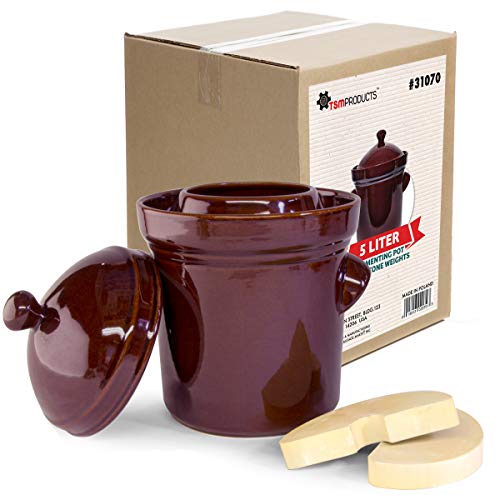
The TSM Products Polish Fermenting Crock 5L at $70 is the most visually striking crock in the mid-range category. Hand-crafted in Poland with a deep Burnt Sienna glaze and included stone weights, it is the crock that makes people ask where you got it. If the Mortier Pilon is mid-century modern, the TSM is old-world handcraft — the kind of crock that belongs in a farmhouse kitchen or a serious home fermentation setup.
This is an open-top crock, and that matters. The TSM does not include a water-seal lid. Fermentation happens in contact with the environment, covered by a cloth or the included lid that rests on top without creating a sealed gas barrier. The traditional method works, but it requires more active attention than water-seal crocks: checking brine levels every one to two days, skimming Kahm yeast when it appears, making sure the stone weights keep everything submerged. For experienced fermenters who find this monitoring routine rather than burdensome, the TSM is a pleasure to use. For beginners who want the set-and-check-weekly convenience of a water-seal crock, it is the wrong choice.
At $70, the TSM sits between the Kenley 4L water-seal crock at $55 and the Mortier Pilon 5L water-seal at $89. On fermentation function, the Kenley and Mortier Pilon offer a more automated experience through water-seal design. The TSM earns its price through craftsmanship and the specific appeal of handmade Polish stoneware. If you appreciate traditional methods and artisan materials, the $70 investment is justified by a vessel you will want to use for decades.
Pros & Cons
Pros
- Hand-crafted in Poland by artisan potters — provenance is real, not marketing
- Burnt Sienna glaze is genuinely attractive — the best-looking crock at this price
- Wide cylindrical shape makes it easy to reach in and pack vegetables tightly
- Stone weights fit the curved bottom snugly, staying in place under brine
- Thick walls provide good thermal mass for stable fermentation temperatures
Cons
- Open-top design requires more attention than water-seal alternatives
- No lid included — you need to source a wooden board or plate that fits
- Heavier than it looks; 5L filled is around 14–15 lbs total
TSM Products Round Polish Fermenting Crock with Stone Weights 5L — Burnt Sienna
Prices may change · Free shipping with Prime
Design & Build Quality
The TSM Polish crock is hand-thrown stoneware, and the difference from machine-formed crocks is tactile. The walls have slight variations in thickness that are the signature of wheel-thrown ceramics rather than mold uniformity. The Burnt Sienna glaze has depth and subtle color variation that photographs as a rich reddish-brown. No two crocks are exactly alike in glaze coverage, which is a feature rather than a defect.
The stoneware is heavy — a full 5-liter crock with vegetables and brine approaches fifteen pounds — and wall thickness is substantial. This is genuine Gairtopf-weight stoneware, not the thinner construction common to machine-formed crocks. Thick walls provide excellent thermal mass that stabilizes fermentation temperature against ambient fluctuations, making the TSM one of the better performers on this dimension in the mid-range price tier.
The open-top design is traditional and functional. A flat stoneware lid rests on the crock rim, covering the contents without creating an airtight or gas-managing seal. Gas exits around the lid perimeter; oxygen can also enter. This is fermentation as practiced for millennia before water-seal airlock technology: relying on CO2 saturation in the brine to suppress oxygen-dependent spoilage organisms. It works reliably when brine concentration is correct and vegetables stay submerged, and it requires active monitoring when it does not.
The included stone weights fit inside the crock to hold vegetables below the brine line. Stone weights have the same porosity concern as those in the Kenley kit — they absorb brine over time and can carry aroma between batches if not cleaned with a vinegar soak between uses. The TSM's stone weights are heavier than most budget-crock equivalents, which reduces the need for secondary pressing improvisation.
Performance & Specifications Deep Dive
Five liters is a practical capacity for active household fermenters. Three to four medium heads of shredded cabbage fill the TSM to about two-thirds capacity after salting and packing, yielding three to four liters of finished sauerkraut. At this volume, a well-timed batch provides a month or more of supply for a two-to-four person household without requiring constant rotation.
For kimchi, the 5-liter capacity and wide cylindrical opening make packing large Napa cabbage leaves comfortable. The substantial weight of the stone weights keeps even buoyant kimchi ingredients firmly submerged. The traditional fermenters' method — ferment 24 to 48 hours at room temperature, then refrigerate — works well with the TSM's open-top design because refrigerator storage naturally suppresses Kahm yeast development after the initial room-temperature phase.
The open-top management protocol for lacto-fermentation in the TSM requires attention but not constant intervention. Check the brine level every one to two days, particularly in the first week of active fermentation when CO2 production displaces brine upward and can push vegetable matter above the brine line. Skim any white Kahm yeast film with a clean spoon when it appears. Taste the brine periodically starting at day five to assess acidity. These checks take two minutes and become habitual quickly for regular fermenters.
Kahm yeast growth is more common in open-top ferments than water-seal crocks, and the TSM is no exception. At proper salt concentration (2% for sauerkraut, 2 to 3% for pickles) and cool-room temperature (65 to 70 degrees Fahrenheit), Kahm development is minimal. In warm summer kitchens above 75 degrees, Kahm spreads faster and fermentation accelerates, producing more acidity than intended. Seasonal management — moving the crock to a basement or cool pantry in summer — is the standard approach.
Real-World Use Cases
The TSM excels for fermenters who treat the process as an ongoing kitchen practice rather than a set-and-forget appliance interaction. A Wisconsin homesteader reported fermenting sauerkraut, kimchi, and whole dill pickles across three TSM crocks purchased over several years, preferring the open-top method specifically because the daily check-in maintained her connection to each batch's development. The Burnt Sienna glaze was a secondary factor — the crocks live on open shelving and are part of the kitchen's visual identity.
For large-batch traditional sauerkraut — the kind made with a whole head of cabbage, perhaps multiple heads from a fall harvest — the TSM's 5-liter capacity and traditional open-top method match the historical process more closely than a water-seal crock. Fermenters following traditional German or Eastern European recipes that predate airlock technology find the TSM authentic to those methods.
For whole-vegetable ferments — cucumbers, green beans, asparagus, beets — the open-top design with its wide mouth accommodates more irregular shapes than water-seal crocks designed around flat weighted lids. Whole cucumbers standing vertically, full green bean bundles, and large beet wedges all pack naturally in the cylindrical interior.
The TSM is less practical for fermenters with small kitchens, warm apartments without climate control, or those who travel and cannot maintain daily monitoring. In these conditions, a water-seal crock like the Mortier Pilon 5L is more forgiving: the sealed lid prevents Kahm yeast development and the moat check is weekly rather than daily.
Who Should Buy This (And Who Shouldn't)
Buy the TSM Polish Fermenting Crock 5L if you have experience with lacto-fermentation, you prefer or are willing to learn the traditional open-top method, and you appreciate handcrafted stoneware aesthetics that a machine-formed crock cannot match. It is right for experienced home fermenters, homesteaders, anyone making large traditional sauerkraut or pickle batches, and buyers who want a vessel they will display in the kitchen rather than store in a cabinet.
Do not buy this crock if you want a water-seal automated experience. At $70, the Kenley 4L ($55) provides water-seal convenience for $15 less, and the Mortier Pilon 5L ($89) provides it with better aesthetics for $19 more. The TSM's trade versus both is active open-top management in exchange for traditional craft and visual distinctiveness. If you find daily check-ins appealing rather than burdensome, it is the right choice. If you want to start a ferment and not think about it for a week, it is not.
Do not buy it as a first fermentation vessel. The open-top method has a learning curve around reading Kahm yeast, managing brine levels, and understanding the smell difference between active healthy fermentation and spoilage. These lessons are better learned with a ball jar kit at $22 before committing to a $70 handcrafted crock.
Alternatives Worth Considering
The Mortier Pilon 5L at $89 is the direct alternative for buyers who want 5-liter capacity but prefer water-seal automation over open-top tradition. The Mortier Pilon costs $19 more, includes ceramic weights rather than stone, and eliminates daily brine monitoring through its water-seal lid. The aesthetic is modern versus the TSM's artisan handcraft. Both are excellent 5-liter mid-range crocks; the choice is about fermentation method preference.
The Ohio Stoneware 1-Gallon Crock at $34.99 is the open-top alternative for buyers who want American-made stoneware and traditional method at lower cost. Ohio Stoneware is slightly smaller (3.8 liters versus 5 liters), uses an open-top design like the TSM, and is made in Zanesville, Ohio. The TSM's superior aesthetics, Polish handcraft, and larger capacity justify the price premium. The Ohio Stoneware wins on domestic origin and price alone.
The Nik Schmitt Gairtopf 5L at $149 is the premium step-up from the TSM for buyers who want 5-liter capacity with water-seal technology and premium German construction. The Nik Schmitt adds $79 over the TSM price; what you get is substantially thicker walls, a water-seal lid system with refined engineering, and a crock that has been produced by the same German manufacturer for generations. If the TSM appeals but you want water-seal convenience, the Nik Schmitt is the premium path.
Our Verdict
The most handsome open-top crock we tested. The Polish craftsmanship is visible in the clay and glaze quality. Worth the upgrade over Ohio Stoneware if aesthetics matter.
TSM Products Round Polish Fermenting Crock with Stone Weights 5L — Burnt Sienna
$70
Prices may change · Free shipping with Prime
| Full Specifications | |
|---|---|
| Vessel Type | Open-Top Crock |
| Capacity | 5L |
| Material | Stoneware |
| Water-Seal Lid | No |
| Weights Included | Yes |
| Stamper Included | No |
| Dishwasher Safe | No |
| Lead-Free Glaze | Yes |
| Made In | Poland |
Frequently Asked Questions
How do I manage Kahm yeast in an open-top crock?
Does hand-crafted mean quality is inconsistent from crock to crock?
Can I use the TSM crock for kimchi that will be refrigerated immediately?
How does the 5-liter TSM compare to the 5-liter Mortier Pilon for sauerkraut?
Related Buying Guides
Compare With Similar Fermentation Crocks
Head-to-Head Comparisons
TSM Products Round Polish Fermenting Crock with Stone Weights 5L — Burnt Sienna
$70
Prices may change · Free shipping with Prime