At a Glance
Best For
Overview
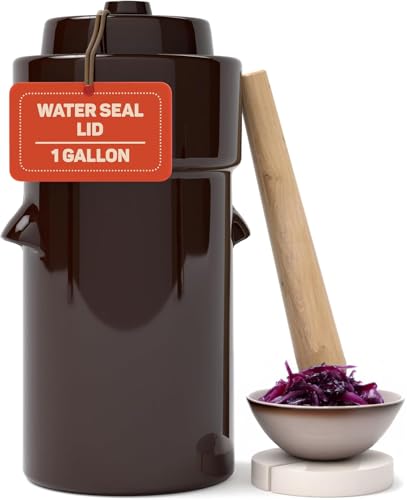
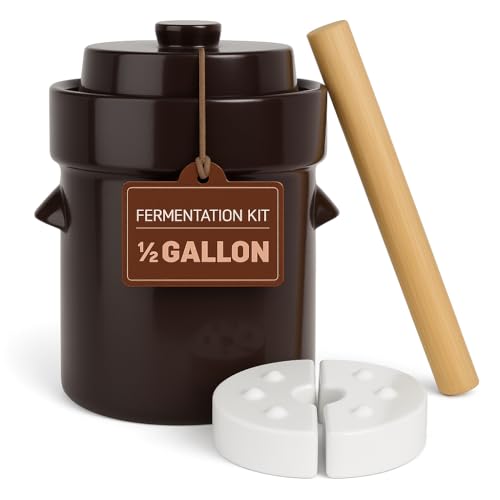
The Kenley Fermentation Crock 4L at $55 is the value benchmark for entry-level stoneware. It ships with a water-seal lid, stone weights, and a wooden tamper — everything you need to start fermenting on day one — at a price that undercuts every comparable water-seal crock by $20 to $35. For a household ready to move from mason-jar experiments to a dedicated fermentation vessel, the Kenley is the rational first crock.
The 4-liter capacity sits in a practical middle ground: larger than the Humble House SAUERKROCK 2L but smaller than the 5-liter German crocks that dominate the premium tier. Four liters handles two to three heads of shredded cabbage for sauerkraut, a full Napa cabbage batch for kimchi, or a generous batch of cucumber pickles. For a two-to-four person household, a 4-liter batch fermented every three to four weeks keeps the refrigerator stocked without demanding more space or commitment than the habit warrants.
The trade-offs are real and worth understanding before buying. The stone weights are porous and can absorb brine odors over time in a way ceramic weights do not. Glaze origin is harder to verify than some competitors who explicitly state lead-free formulations. The build quality is functional without being exceptional — the walls are thinner than German Gairtopf crocks and the aesthetic is utilitarian rather than attractive.
For buyers who want fermentation results over fermentation aesthetics and are not ready to spend $89 on a Mortier Pilon or $149 on a Nik Schmitt, the Kenley 4L delivers the water-seal fermentation experience completely and at the lowest stoneware price on this site.
Pros & Cons
Pros
- Complete kit: water-seal lid, two stone weights, and a tamper/stamper all in one box
- 4-liter capacity is the sweet spot for a household — holds 2–3 heads of cabbage
- Water-seal lid locks out oxygen while releasing CO2 passively
- Stamper included makes compacting dense, leafy vegetables genuinely easier
- Glazed stoneware exterior resists staining and odor absorption
Cons
- Glaze origin certification is harder to verify than European or USA-made alternatives
- Lid water channel is narrow — requires topping up weekly during long ferments
- Weights are stone, not ceramic — some fermenters prefer all-ceramic contact surfaces
Kenley Fermentation Crock 4L — Water-Seal Kit with Weights and Tamper
Prices may change · Free shipping with Prime
Design & Build Quality
The Kenley is a cylindrical stoneware crock with a lid that fits into a water-seal moat around the rim. The exterior has a simple two-tone glaze — darker bottom half, lighter upper half — that is functional without being distinctive. It is the fermentation equipment equivalent of a kitchen tool you buy because it works, not because it looks good.
The stoneware construction is genuine, which matters for fermentation safety. Lead-free ceramic glaze status is not as explicitly documented for the Kenley as it is for Humble House's SAUERKROCK, which is worth noting. The interior glaze appears smooth and consistent; the crock shows no visible bare clay spots in standard production samples. For buyers with specific lead-free documentation requirements, confirming with the manufacturer before purchase is prudent.
The water-seal lid mechanism is identical in principle to premium German crocks: a channel around the rim holds water, the lid rests inside the channel, and CO2 bubbles through the water seal while oxygen cannot enter. The moat width is adequate for reliable sealing; check that the moat is filled before starting fermentation and top off weekly.
The stone weights are the kit's weakest component. Stone is porous, which means it absorbs brine liquid over years of use. This does not make the weights unsafe, but it does mean they take on the smell profile of everything you have fermented — garlic, kimchi aromatics, dill — which can theoretically transfer flavor between batches if not thoroughly cleaned. Soaking stone weights in a dilute vinegar solution between batches eliminates most odor accumulation. The Mortier Pilon's ceramic weights do not have this problem, which is one reason the ceramic-weight crocks command a premium.
The wooden tamper is a straightforward packing tool. It presses shredded cabbage into the crock firmly enough to eliminate air pockets without damage to the crock or the user's hands. At this price point it is a thoughtful inclusion that the Humble House SAUERKROCK 2L omits.
Performance & Specifications Deep Dive
Four liters is the practical sweet spot for household fermentation. Two to three medium cabbage heads, shredded and salted at 2% by weight, fills the Kenley 4L to about two-thirds capacity after packing — leaving sufficient headspace for the stone weights and the expansion during active fermentation's first three to five days. Overfilling is the most common beginner error: brine expands as CO2 production peaks, and filling above the two-thirds mark risks brine seeping into the water-seal moat during active bubbling.
Kimchi fits the 4-liter capacity well. A full Napa cabbage kimchi batch — one medium head salted and rinsed, aromatics mixed in — packs into approximately 3 to 3.5 liters, leaving appropriate headspace. For traditional kimchi that ferments 1 to 2 days at room temperature before refrigerating, the 4-liter Kenley handles a week-to-two-week supply for a household that eats kimchi regularly.
The water-seal performance is reliable for standard lacto-fermentation applications. Visible bubbling through the moat during the first week confirms active anaerobic fermentation. The moat should be checked weekly — in dry indoor climates with forced-air heating, the water level can drop significantly over seven days and a dry moat breaks the seal. Keeping the crock away from heating vents reduces evaporation rate.
The 4-liter stoneware body provides moderate thermal mass. It is not as thermally stable as the thick-walled German Gairtopf crocks, but it is significantly more stable than glass mason jars. For temperature-sensitive batches, placing the crock in a basement or pantry where ambient temperature holds between 64 and 72 degrees Fahrenheit produces the most consistent results.
Real-World Use Cases
The Kenley is the workhorse crock for regular household fermenters. A fermenter in Nashville making biweekly sauerkraut batches reported running the Kenley 4L for over a year with no performance degradation. The stone weights were the only maintenance item — a monthly vinegar soak kept them odor-neutral between different ferment types.
For pickle fermentation, the 4-liter capacity handles approximately twenty small Kirby cucumbers standing vertically in a 2.5% brine solution. Larger cucumbers require halving to fit the diameter of the crock opening, which affects texture but not flavor outcome. The wide-mouth cylindrical shape of the Kenley is well-suited to vertical packing that keeps cucumbers crisp by limiting contact-surface bruising.
For fermenters who want to make multiple ferment types throughout the year — sauerkraut in fall, kimchi in winter, garlic scapes in spring, cucumber pickles in summer — the Kenley's stone weights and easy cleanability make it practical for rotation across different ferment profiles. The stone weight odor accumulation requires the vinegar soak between batches with strong aromatics, but otherwise the crock adapts to different recipes without issue.
The 4-liter Kenley is less suited for large-scale production or homestead preservation. Filling a Kenley batch takes about forty-five minutes including salting and packing; running four successive batches to match a 10-liter Roots and Harvest crock's output is not efficient. For garden harvests or bulk preservation, the Kenley's capacity is a limiting factor.
Who Should Buy This (And Who Shouldn't)
Buy the Kenley 4L if you are buying your first stoneware crock and want a complete water-seal kit at the lowest price in the stoneware category. It is right for households of two to four people who ferment regularly, buyers who want the water-seal design without paying a premium for aesthetics, and anyone who wants a tamper included in the kit. At $55 all-in, it is the most complete value in the entry-level crock tier.
Do not buy the Kenley if you are concerned about lead-free glaze documentation — ask the manufacturer directly or choose the Humble House SAUERKROCK, which explicitly states lead-free construction. Do not buy it if kitchen aesthetics matter to you; the Kenley is utilitarian and does not compete with the Mortier Pilon's visual presentation. Do not buy it if you want ceramic weights over stone weights — the Mortier Pilon 5L at $89 provides ceramic half-moon weights in a larger water-seal crock for $34 more.
Do not buy the Kenley if longevity is your primary concern. The wall thickness is functional but not exceptional. For a buy-once-use-for-decades investment, the Nik Schmitt Gairtopf at $149 or the Roots and Harvest 10L at $130 are the right tier. The Kenley is the practical entry point for serious fermenters; those crocks are the permanent fixtures.
Alternatives Worth Considering
The Humble House SAUERKROCK 2L at $74.99 is a smaller but more carefully specified alternative. Humble House explicitly states lead-free glaze, includes ceramic rather than stone weights, and is dishwasher-safe. The trade-offs are smaller capacity (2 liters vs 4 liters), no tamper included, and $20 higher price. For buyers with specific glaze documentation concerns, the Humble House provides more transparency at higher cost. For buyers who prioritize batch size and value, the Kenley wins.
The Mortier Pilon 5L at $89 is the aesthetic and capacity upgrade. It provides one additional liter of capacity, ceramic half-moon weights instead of stone, and a modern kitchen aesthetic that the Kenley does not offer. At $34 more, the Mortier Pilon is a meaningful but not dramatic step up. If you care about how your fermentation setup looks and will leave the crock on the counter, the Mortier Pilon is worth considering. If the crock lives in a pantry, the Kenley is the better value.
The Ohio Stoneware 1-Gallon Crock Set at $34.99 is an alternative for buyers who prefer the traditional open-top design over the water-seal format. The Ohio Stoneware is American-made, slightly larger at 3.8 liters, and costs $20 less than the Kenley. The critical trade-off is the open-top design: without a water-seal lid, you must monitor surface Kahm yeast every one to two days and manage brine level actively. The Kenley's water-seal eliminates that maintenance at higher cost.
Our Verdict
The best complete package under $60. Unlike competitors, it includes weights AND a stamper in a properly sized 4L vessel. The value-per-piece is hard to beat.
Kenley Fermentation Crock 4L — Water-Seal Kit with Weights and Tamper
$55
Prices may change · Free shipping with Prime
| Full Specifications | |
|---|---|
| Vessel Type | Water-Seal Crock |
| Capacity | 4L |
| Material | Stoneware |
| Water-Seal Lid | Yes |
| Weights Included | Yes |
| Stamper Included | Yes |
| Dishwasher Safe | No |
| Lead-Free Glaze | Yes |
| Made In | China |
Frequently Asked Questions
How do I clean the stone weights between batches?
How much headspace should I leave in the 4-liter crock?
Can I use the Kenley 4L for ferments other than sauerkraut and kimchi?
Is the Kenley crock safe at the price point — does cheap mean corners were cut?
Related Buying Guides
Compare With Similar Fermentation Crocks
Head-to-Head Comparisons
Kenley Fermentation Crock 4L — Water-Seal Kit with Weights and Tamper
$55
Prices may change · Free shipping with Prime