At a Glance
Best For
Overview
The Roots and Harvest Traditional Water-Seal Crock 10L at $130 is for fermenters who have graduated from household batches and want to preserve at scale. Ten liters is not a casual purchase — it is a commitment to fermentation as a preservation practice: processing fall cabbage harvests, making kimchi in quantities that last a Korean winter, or running continuous sauerkraut production for a large family or small market.
At 10 liters, this crock handles what no other vessel in this comparison can match for volume. The Nik Schmitt Gairtopf 5L at $149 and the Mortier Pilon 5L at $89 provide excellent 5-liter water-seal fermentation; the Roots and Harvest doubles their output per batch at $130. For a homesteader who wants to put up a winter's supply of sauerkraut in one or two crock sessions, the math is straightforward: fewer batches, more output, same fermentation quality.
This is a water-seal crock. The design follows the same principles as every water-seal vessel on this site: a channel around the rim holds water, the lid sits inside the channel, CO2 bubbles out, oxygen cannot enter. For 10 liters of vegetables and brine, the water-seal design is especially valuable because you cannot check and manage a 10-liter open-top crock as casually as a 2-liter mason jar ferment. The water-seal's passive gas management makes large-format fermentation practical for home cooks who are not professional cheesemakers or pickle producers.
The trade-off at this capacity is weight. A full 10-liter crock approaches thirty pounds. You are not moving this to the basement and back casually. Choose your fermentation location before filling it.
Pros & Cons
Pros
- 10-liter capacity handles a full 5-head-of-cabbage sauerkraut batch in one vessel
- Traditional water-seal moat design passively vents CO2 while excluding oxygen and pests
- Fully vitrified stoneware — denser and more durable than lower-fired alternatives
- Built-in side handles make the crock manageable even when full
- Lead-free, food-safe glaze verified by Roots & Harvest with certification documentation
Cons
- Expensive at $130+ — a serious commitment for a first purchase
- 10L is a lot of vegetable; smaller households may not fill it efficiently
- Heavy when full — approaching 25–30 lbs fully loaded, not easy to relocate
Roots and Harvest 10L Traditional Water-Seal Fermentation Crock with Lid and Weights
Prices may change · Free shipping with Prime
Design & Build Quality
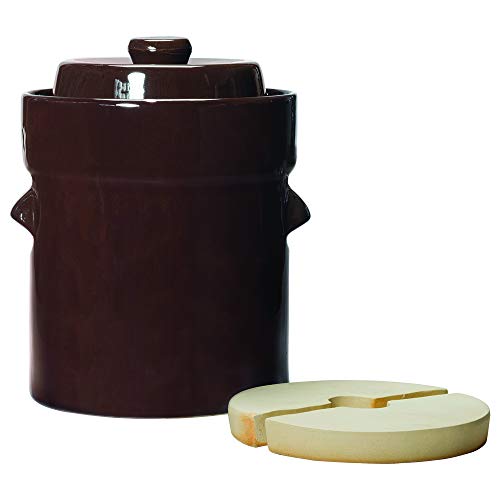
The Roots and Harvest 10L crock is a substantial vessel — wider in circumference and taller than any other crock reviewed on this site. The stoneware body uses a traditional American crock form: cylindrical with a slightly flared mouth, earthy buff glaze with minimal ornamentation. The aesthetic is working-kitchen utilitarian, the kind of equipment that belongs in a farmhouse or a serious homesteader's preservation pantry.
The water-seal lid follows the standard Gairtopf principle adapted to American manufacturing. The lid rim fits inside a water-filled channel around the crock mouth, creating a one-way gas barrier that allows CO2 to escape while blocking oxygen inflow. At 10 liters of active brine under fermentation, the CO2 output during the first week of active fermentation is substantial — you will see and hear regular bubbling through the water seal. The moat should hold enough water to handle this gas volume without running dry; check and top off every two to three days during active fermentation in the first week.
The included stone weights are sized for the 10-liter interior. At this scale, weights are not a cosmetic nicety — a 10-liter crock of unsupported cabbage can have significant vegetable mass floating above the brine line, which invites mold. The stone weights for the Roots and Harvest are heavier than those in smaller crocks to provide adequate downward pressure on a larger vegetable mass.
The stoneware body is thick and durable. Unlike some imported mid-range crocks where wall thickness is a cost-saving variable, the Roots and Harvest uses sufficient thickness to provide meaningful thermal mass at the 10-liter scale. A full crock maintains stable temperature through daily kitchen temperature swings — especially relevant at this volume, where an overly fast fermentation from summer kitchen heat can produce extremely sour sauerkraut before you have had a chance to taste and refrigerate.
Performance & Specifications Deep Dive
Ten liters of fermentation capacity accommodates six to eight medium cabbage heads for sauerkraut — roughly eight to ten liters of finished product after shrinkage and brine displacement. At this output, a well-timed annual autumn batch produces three to four months of sauerkraut supply for a household that eats ferments daily. For families preserving from a garden harvest, a single crock session can process most of a fall cabbage crop.
For kimchi, 10 liters matches traditional Korean household kimchi-making quantities: a full gimjang batch made once or twice a year to last through winter. Two to three large Napa cabbages, salted and rinsed, packed with aromatics and gochugaru, fills the crock to two-thirds capacity. A gimjang batch fermented 24 hours at room temperature then moved to cool storage — or to a traditional kimchi refrigerator — benefits from the Roots and Harvest's stable temperature holding during the initial room-temperature fermentation phase.
The water-seal moat at 10-liter scale requires more water than smaller crocks and more frequent checking during active fermentation. Fill the moat fully before sealing the lid. During the first week of active fermentation, CO2 production from 10 liters of fermenting cabbage is significant, and the bubbling can accelerate water evaporation from the moat. Checking every two to three days during active fermentation ensures the moat stays sealed. After the first week, fermentation slows and weekly moat checks are sufficient.
The crock's weight when full — approximately twenty-eight to thirty pounds — is a critical planning consideration. Choose the fermentation location before filling: a counter or low shelf you can access easily for lid checking without lifting the crock. Once full, the crock should not be moved. For cellaring or cool-storage fermentation, the filled crock needs to travel to that location before or during initial packing, not after.
Real-World Use Cases
The Roots and Harvest 10L is built for homesteaders and serious preservation-minded home cooks. A Vermont homesteader reported filling the crock once in September with eight heads of garden cabbage, fermenting for four weeks in a 58-degree root cellar, and having sauerkraut through February without making another batch. The 10-liter output matched her household consumption rate precisely at one to two cups per week for two people.
For traditional gimjang kimchi-making, the 10-liter crock matches the historical portion that Korean households would have fermented for a family of four. Multiple large Napa cabbages, with radish cubes and a standard aromatics blend of gochugaru, fish sauce, garlic, and ginger, pack naturally in the 10-liter format. Many Korean-American households report that the Roots and Harvest closely matches the onggi pot scale their families used, though the American stoneware construction differs from the traditional unglazed ceramic onggi.
For small-scale commercial fermenters selling at farmers markets or through community-supported agriculture programs, the 10-liter crock is a practical production vessel. A quart jar of finished sauerkraut sells for $8 to $12 at premium markets; a 10-liter batch produces approximately eight to ten jars. The Roots and Harvest economics are favorable at this small production scale.
The crock is less suited for casual household fermenters who make small batches occasionally. At $130, the investment requires consistent use to justify. If you ferment two to three times a year or maintain batches under 3 liters per cycle, a Kenley 4L at $55 or Mortier Pilon 5L at $89 is more appropriately scaled.
Who Should Buy This (And Who Shouldn't)
Buy the Roots and Harvest 10L if you preserve from a home garden and want to process large vegetable quantities in a single session, you make traditional kimchi in gimjang quantities for seasonal supply, you feed a large household that consumes fermented vegetables daily, or you are a small-scale producer fermenting for market. This is the right crock for fermenters who have already established a regular practice and want to scale batch size rather than batch frequency.
Do not buy the Roots and Harvest if you are new to fermentation. The 10-liter investment — in both money and vegetable quantities — is high-stakes for a beginner who may discover that fermentation is not for them, or who makes a salt-ratio mistake and loses the whole batch. Start with the Ball kit at $22 or the Kenley 4L at $55. The 10-liter crock is a graduation purchase, not a starter purchase.
Do not buy it if you have limited physical strength or mobility. Moving a 28-pound crock when full is physically demanding, and the crock must be accessible for moat checking without lifting. If your ideal fermentation location involves stairs or lifting, the 5-liter crock format is more practical. The Nik Schmitt Gairtopf 5L at $149 is a premium-quality alternative at half the Roots and Harvest's output volume.
Alternatives Worth Considering
The Nik Schmitt Gairtopf 5L at $149 is the premium comparison: half the capacity at $19 more. The Nik Schmitt's advantage is German engineering refinement, a water-seal system with a centuries-long track record, and a crock form that weighs roughly half as much when full. For households that want premium water-seal fermentation at a manageable size, the Nik Schmitt is a better fit. For households that want raw volume, the Roots and Harvest doubles the output per batch at lower cost.
The TSM Products Polish Fermenting Crock 5L at $70 is a comparable aesthetic alternative in an open-top format. At $60 less, the TSM provides 5 liters of handcrafted Polish stoneware fermentation, but without the water-seal lid that makes 10-liter fermentation manageable. For a 5-liter batch, open-top monitoring is practical. For a 10-liter batch, the water-seal design that the Roots and Harvest provides is worth the capacity premium.
For buyers who want 10-liter scale but prefer the traditional German Gairtopf design, European imports in the 10 to 15-liter range exist at $150 to $200 from manufacturers like Harsch or Gartopf. These carry more German pedigree than the Roots and Harvest but come at higher cost and with international shipping considerations. For American-made large-format water-seal fermentation at the $130 price point, the Roots and Harvest is the practical domestic choice.
Our Verdict
The right crock for fermenters who've outgrown the 2L–5L range and want to produce in bulk. The water-seal design, vitrified stoneware, and 10L capacity justify the premium price.
Roots and Harvest 10L Traditional Water-Seal Fermentation Crock with Lid and Weights
$130
Prices may change · Free shipping with Prime
| Full Specifications | |
|---|---|
| Vessel Type | Water-Seal Crock |
| Capacity | 10L |
| Material | Stoneware |
| Water-Seal Lid | Yes |
| Weights Included | Yes |
| Stamper Included | No |
| Dishwasher Safe | No |
| Lead-Free Glaze | Yes |
| Made In | China |
Frequently Asked Questions
How many heads of cabbage fit in a 10-liter crock?
How do I move a full 10-liter crock safely?
Is a 10-liter batch of sauerkraut safe to ferment at room temperature?
How does the water-seal design help with 10-liter fermentation specifically?
Related Buying Guides
Compare With Similar Fermentation Crocks
Head-to-Head Comparisons
Roots and Harvest 10L Traditional Water-Seal Fermentation Crock with Lid and Weights
$130
Prices may change · Free shipping with Prime